About The Man Who Shot Liberty Valance
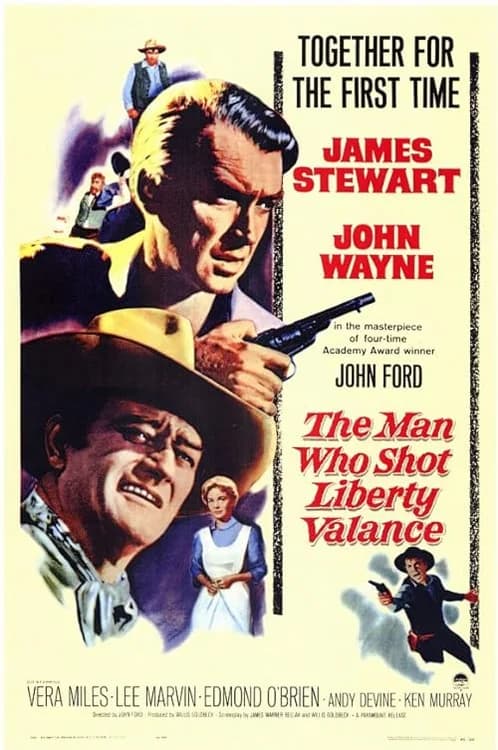
John Ford's 1962 masterpiece 'The Man Who Shot Liberty Valance' stands as one of the most intelligent and morally complex Westerns ever made. The film follows Senator Ransom Stoddard (James Stewart) as he returns to the town of Shinbone for the funeral of his old friend Tom Doniphon (John Wayne). Through extended flashbacks, Stoddard recounts how he arrived as an idealistic young lawyer determined to bring law and order to the territory, only to clash with the brutal outlaw Liberty Valance (Lee Marvin). The film builds toward the legendary shootout that made Stoddard famous, before revealing the shocking truth behind the myth.
The performances are exceptional across the board. James Stewart brings his trademark earnestness to the role of Stoddard, while John Wayne delivers one of his most nuanced performances as the tough but principled Doniphon. Their contrasting approaches to justice—civilization versus frontier justice—create the film's central tension. Lee Marvin is terrifying as the sadistic Valance, and Vera Miles provides strong support as the woman caught between the two protagonists.
Director John Ford, working in stark black-and-white rather than his usual vibrant Technicolor, creates a film that deliberately deconstructs the Western myths he helped create. The screenplay is brilliantly structured, moving between past and present to explore how legends are born from uncomfortable truths. The famous line 'When the legend becomes fact, print the legend' encapsulates the film's central theme about the stories societies choose to believe.
Viewers should watch 'The Man Who Shot Liberty Valance' not just as a Western, but as a profound meditation on American history, myth-making, and the transition from frontier violence to civilized society. Its exploration of how heroes are created and truths are buried remains remarkably relevant. The film's intelligent script, superb performances, and thoughtful direction make it essential viewing for anyone interested in cinema's ability to examine national identity and historical memory.
The performances are exceptional across the board. James Stewart brings his trademark earnestness to the role of Stoddard, while John Wayne delivers one of his most nuanced performances as the tough but principled Doniphon. Their contrasting approaches to justice—civilization versus frontier justice—create the film's central tension. Lee Marvin is terrifying as the sadistic Valance, and Vera Miles provides strong support as the woman caught between the two protagonists.
Director John Ford, working in stark black-and-white rather than his usual vibrant Technicolor, creates a film that deliberately deconstructs the Western myths he helped create. The screenplay is brilliantly structured, moving between past and present to explore how legends are born from uncomfortable truths. The famous line 'When the legend becomes fact, print the legend' encapsulates the film's central theme about the stories societies choose to believe.
Viewers should watch 'The Man Who Shot Liberty Valance' not just as a Western, but as a profound meditation on American history, myth-making, and the transition from frontier violence to civilized society. Its exploration of how heroes are created and truths are buried remains remarkably relevant. The film's intelligent script, superb performances, and thoughtful direction make it essential viewing for anyone interested in cinema's ability to examine national identity and historical memory.